

Is your school’s website beautiful? Does it need to be? What would it even mean for a website to be beautiful? (Website designers don’t need the skills of Raphael or Rembrandt, do they?)
Roger Scruton, the British philosopher best known for his writings on conservatism and aesthetics, offers school administrators and marketers a helpful perspective on these questions. In Beauty: A Very Short Introduction, he distinguishes between the distinct ways beauty reveals itself in different settings. A great work of art is beautiful in one way, and everyday objects can be beautiful in another:
Things can often be compared and ranked according to their beauty, and there is also a minimal beauty—beauty in the lowest degree, which might be a long way from the ‘sacred’ beauties of art and nature which are discussed by the philosophers.
There is an aesthetic minimalism exemplified by laying the table, tidying your room, designing a website, which seems at first sight quite remote from the aesthetic heroism exemplified by Bernini’s St Teresa in Ecstasy or Bach’s Well-Tempered Clavier.
You don’t wrestle over these things as Beethoven wrestled over the late quartets, nor do you expect them to be recorded for all time among the triumphs of artistic achievement.
Nevertheless, you want the table, the room or the website to look right, and looking right matters in the way that beauty generally matters — not by pleasing the eye only, but by conveying meanings and values which have weight for you and which you are consciously putting on display (emphasis added).
Is your website beautiful?
Beauty in this scenario doesn’t mean your website is a work of art fit for display in a museum. It also doesn’t require busting your budget to pay for it. It doesn’t have to be showy. But it should be fitting, and it should be a harmony between its form and its purpose in a way that “convey[s the] meanings and values which have weight for you and which you are consciously putting on display.”
For your particular school, what are those meanings and values that define who you are? How do you want to communicate these with prospective families?
Answers may differ from school to school, but every classical school has at least two values in common: (1) a commitment to excellence and (2) a love of beauty.
(1) Commitment to Excellence
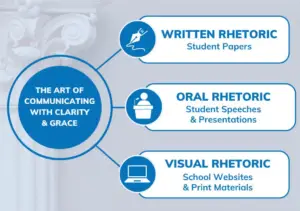
If someone claims to be an excellent student, his teachers would naturally expect his papers and speeches to reveal depth of insight, attention to detail, and skillful rhetoric. A school should hold its website to the same standards.
There are plenty of ways a school can use its website to tell of its commitment to excellence: test scores, college admissions rates, reading lists, teacher credentials, accreditation records, student and parent testimonials, etc. But a beautiful website will also show a school’s commitment to excellence through its well-crafted content and pleasing design.
A school might ask: if one of our seniors turned in this website for an assignment, how would we evaluate it? Consider an assessment based on the first three canons of classical rhetoric:
- Invention – Is the content relevant and compelling? Does it employ logos, pathos, and ethos to make a persuasive case for the school? Is there a clear thesis statement in the form of a call to action?
- Arrangement – Is the website’s structure user-friendly and intuitive? Can visitors find what they are looking for quickly and easily?
- Style – Is the content well written? Does it communicate its message clearly, concisely, and eloquently? Is there evidence of attentiveness to detail? Is it free of spelling and grammar errors? Do all of the links function properly?
The content a school posts to its website will inevitably send a message about its academic standards. Is your message accurate?
(2) Love of Beauty
A beautiful website is one that successfully displays its values. For classical schools, one of these values is beauty itself. What does your website’s design reveal about your aesthetic sensibilities?
Imagine walking into a classroom and seeing a beautiful framed picture on the wall with three elegantly written words: “Truth, Goodness, Beauty.” You then look around the room and witness a disaster: trash on the floor, books falling off the shelves, broken window blinds, tacky posters on the walls, and neglected papers and empty soda cans scattered across the teacher’s desk. Looking back at the framed picture, you re-read those words: “Truth, Goodness, Beauty.” You walk out of the room ready to give the teacher the benefit of the doubt when it comes to truth and goodness, but skeptical of his love and appreciation for beauty.
A poorly designed website can also send mixed messages. A school may claim to value beauty, and perhaps that school truly does an excellent job when it comes to what is taught in the classroom. But a website with fuzzy pictures, mismatched colors, a homemade logo, and other graphic design gaffes will have difficulty communicating this with visitors no matter how many times the word “beauty” is used.
Your 24/7 Open House
Is your school’s website beautiful? It does not need to be the most impressive, expensive, high-tech site to embody the “aesthetic minimalism” of which Roger Scruton wrote. What matters most is that it conveys “meanings and values which have weight for you and which you are consciously putting on display.” This means both telling and showing a school’s commitment to academic excellence, love of beauty, and other compelling qualities through well-written content and engaging design.
A school’s website is essentially an Open House that prospective families can visit twenty-four hours a day, seven days a week. What kinds of preparations go into creating a welcoming environment for an Open House? How do you make your school building attractive and inviting? How do you want your guests’ experience to shape their impressions of the school?
Designing a website, similarly, requires your school to think carefully, plan strategically, and communicate eloquently about how you can best introduce yourself to prospective families. If you succeed, your website will be both effective and beautiful.
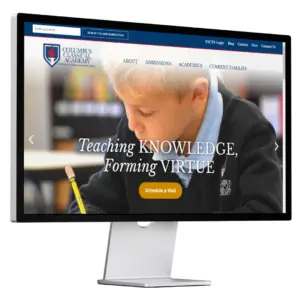
We love helping schools make their websites beautiful. For examples of schools we work with, check out these sites:

A well-established classical Christian school with excellent academics and a thriving community for the entire family.

A Hillsdale College Curriculum School that describes itself as “a civic institution with a biblical foundation.”

A brand-new school drawing from the best ideas and practices of the Association of Classical & Christian Schools.